The Metaphysics of Relations by Anna Marmodoro & David Yates
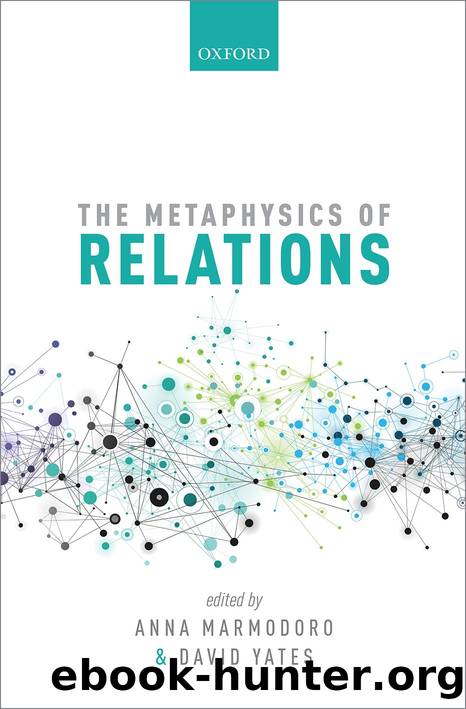
Author:Anna Marmodoro & David Yates [Marmodoro, Anna & Yates, David]
Language: eng
Format: epub
ISBN: 9780198735878
Publisher: OUP Oxford
Published: 2015-10-29T00:00:00+00:00
Langton and Lewis treat intrinsic properties as those that cannot differ between duplicates, where x and y are duplicates iff they share all the same basic intrinsic properties, and P is basic intrinsic iff P is (i) non-disjunctive and contingent, and (ii) independent of accompaniment. Here, P is independent of accompaniment iff, possibly (a) there is a lonely P, (b) there is a non-lonely P, (c) there is a lonely non-P, (d) there is a non-lonely non-P. An object is lonely at a world iff there exist at its world no other contingent, wholly distinct objects.5 Intuitively, the idea is that basic intrinsic properties are those natural properties such that having or lacking them is independent of the existence or non-existence of anything else. The intrinsic properties of x are its basic intrinsic properties plus whatever other contingent properties are in common to every possible basic intrinsic duplicate y of x. I need not endorse this proposal in full generality here. I shall appeal only to the following necessary condition on intrinsicality: if a property P is intrinsic, then possibly, there exists a lonely P.6 If the power to dissolve salt is an intrinsic property of this sample of water, then something could have this power in an otherwise empty world.
Internal relations are determined by the intrinsic properties of the relata. On the current conception of intrinsic properties as those that cannot differ between basic intrinsic duplicates, internal relations are most naturally conceived as those that cannot differ between ordered n-tuples of basic intrinsic duplicates. Pick any n-ary relation R you like, and any ordered n-tuple (x1,â¦, xn). If R is an internal relation, then R(x1,â¦, xn) iff necessarily, for any ordered n-tuple (y1,â¦, yn) such that for any i, yi is a basic intrinsic duplicate of xi, R(y1,â¦, yn). Duplicate the relata as to all natural properties that are independent of accompaniment, and you thereby duplicate any internal relations in which the elements stand. A consequence of this viewâon the assumption that relations that hold in virtue of basic intrinsic properties of the relata are themselves natural propertiesâis that internal relations are also intrinsic to their relata, since they can hold, or fail to hold, independently of accompaniment, and cannot differ between basic intrinsic duplicates.7
Several other extant accounts agree that the possibility of loneliness is necessary for intrinsicality. Vallentyne, for instance, argues that intrinsic properties are those an object x would retain if everything else (objects distinct from x, and even regions of spacetime not occupied by x) were subtracted from the world.8 Vallentyne analyses intrinsicality not in terms of properties possessed by all possible duplicates of x, but in terms of properties x itself would retain if everything else were taken away.9 This account implies that if P is intrinsic to x, then there could be a lonely Pâx itself, once everything that is not x has been removed. Francescotti analyses intrinsicality in terms of non-relationalityâroughly, properties intrinsic to x are those properties x has but does not
Download
This site does not store any files on its server. We only index and link to content provided by other sites. Please contact the content providers to delete copyright contents if any and email us, we'll remove relevant links or contents immediately.
| Anthropology | Archaeology |
| Philosophy | Politics & Government |
| Social Sciences | Sociology |
| Women's Studies |
Cecilia; Or, Memoirs of an Heiress — Volume 1 by Fanny Burney(32558)
The Great Music City by Andrea Baker(32020)
Cecilia; Or, Memoirs of an Heiress — Volume 2 by Fanny Burney(31956)
Cecilia; Or, Memoirs of an Heiress — Volume 3 by Fanny Burney(31942)
We're Going to Need More Wine by Gabrielle Union(19047)
All the Missing Girls by Megan Miranda(16031)
Pimp by Iceberg Slim(14508)
For the Love of Europe by Rick Steves(14124)
Bombshells: Glamour Girls of a Lifetime by Sullivan Steve(14077)
Talking to Strangers by Malcolm Gladwell(13371)
Norse Mythology by Gaiman Neil(13370)
Fifty Shades Freed by E L James(13243)
Mindhunter: Inside the FBI's Elite Serial Crime Unit by John E. Douglas & Mark Olshaker(9344)
Crazy Rich Asians by Kevin Kwan(9293)
The Lost Art of Listening by Michael P. Nichols(7506)
Enlightenment Now: The Case for Reason, Science, Humanism, and Progress by Steven Pinker(7314)
The Four Agreements by Don Miguel Ruiz(6765)
Bad Blood by John Carreyrou(6622)
Weapons of Math Destruction by Cathy O'Neil(6281)
